 by
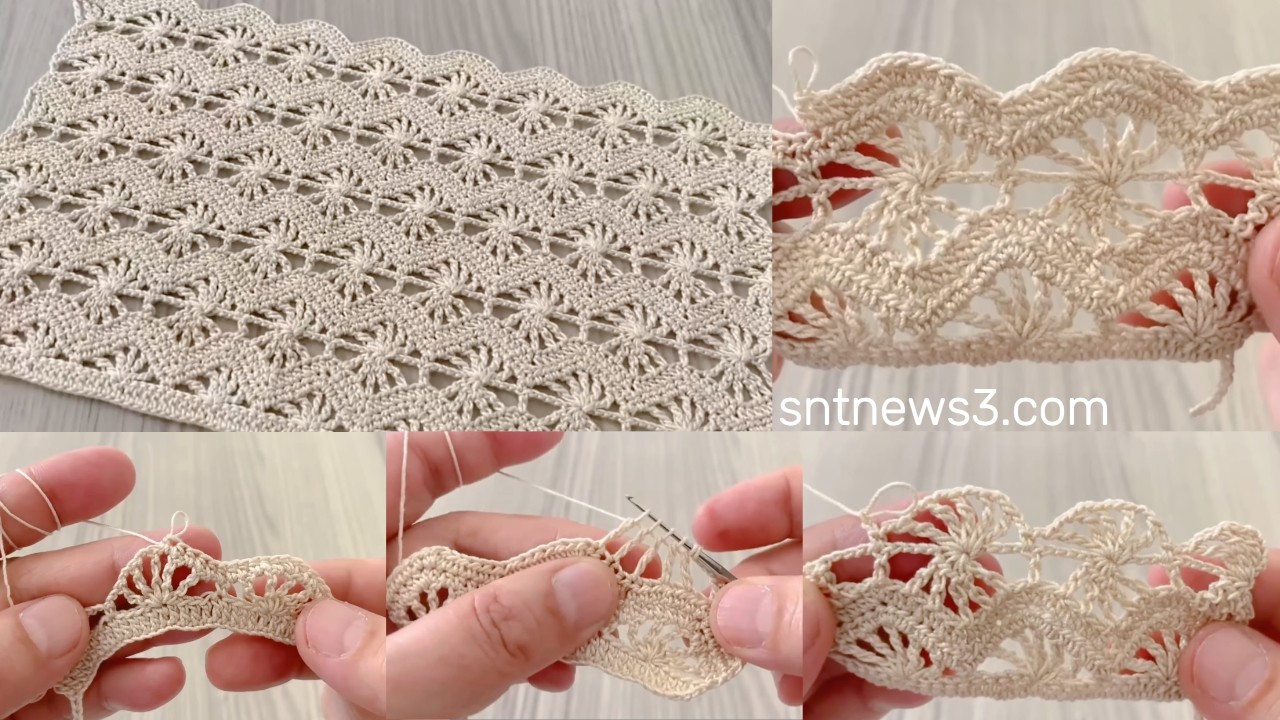
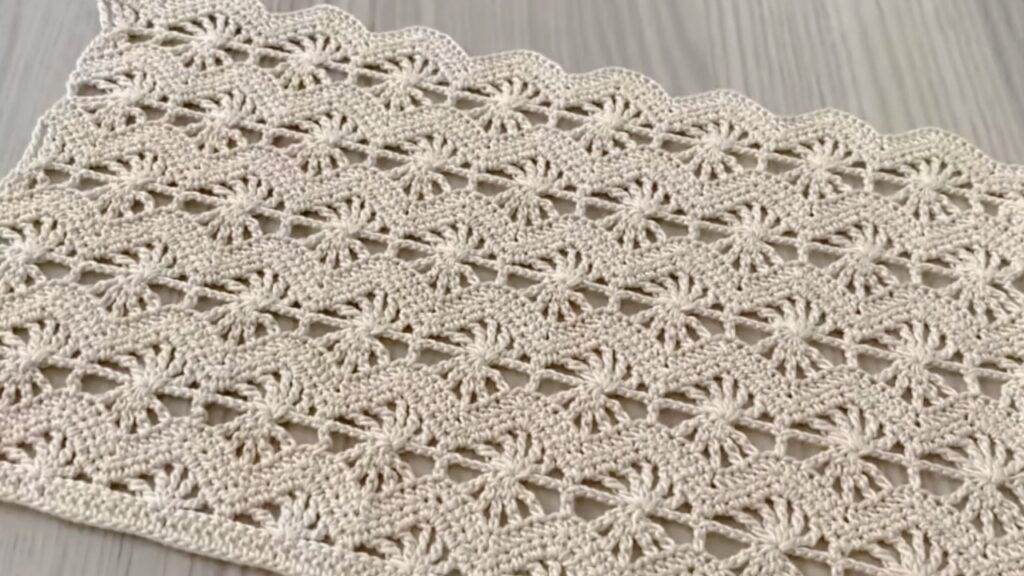
by Nice pick — below is a complete, beginner-friendly step-by-step text tutorial so you can make a lovely lacy blouse. It’s written to use a joinable square motif (medallion → square) and Join-As-You-Go (JAYG) on the final round so you can build a one-piece blouse with minimal sewing. I give exact round instructions, stitch-count checks, layout & sizing guidance, blocking/finishing, sleeve options and troubleshooting. US terms.
Materials & tools
- Yarn: sport / DK (cotton or cotton-blend recommended for summer; softer blend for drapier garments)
- Hook: 3.5–4.5 mm (adjust to your yarn and desired drape)
- Notions: tapestry needle, blocking pins/mat or towel, stitch markers, scissors, measuring tape.
- Test motif (blocked): ~9–13 cm / 3.5–5 in (make a sample motif to decide size).
Abbreviations (US)
- ch = chain
- sl st = slip stitch
- sc = single crochet
- hdc = half double crochet
- dc = double crochet
- tr = treble crochet
- pic = picot (ch 3, sl st into same st)
- sp = space
- rep = repeat
Pattern overview (what you’ll crochet)
- A square motif worked in rounds: centre → petals → arches → square conversion → scalloped outer round.
- Make motifs and JAYG on the scallop round to assemble panels/one-piece blouse.
- Shape neckline & armholes by skipping joins where needed.
- Block motifs as you go for accurate joins and neat finish.
Motif — round-by-round (US terms)
Work rounds joined with sl st unless noted. After each Check: confirm the count.
Round 1 — centre
- Make a magic ring. ch 3 (counts as dc), work 15 dc into ring. (ch-3 + 15 dc = 16 dc.)
- Pull ring closed, sl st to top of ch-3 to join.
Check: 16 dc
Round 2 — loop foundation (petal scaffolding)
- ch 4, sk next dc, sc in next dc — repeat around.
→ 8 ch-4 loops separated by sc. Join.
Check: 8 ch-4 spaces
Round 3 — puffy petals (8 petals)
- In each ch-4 loop work (sc, hdc, 7 dc, hdc, sc) — all into same loop.
- Sl st into next loop and repeat ×8. Join.
Check: 8 petals visible
(Use 5 dc instead of 7 dc for smaller petals)
Round 4 — tidy sc round
- Rejoin between petals. Work sc evenly around petal bases to flatten; aim ~9–12 sc distributed per petal area. Join.
Check: circle lies flat (not cupped)
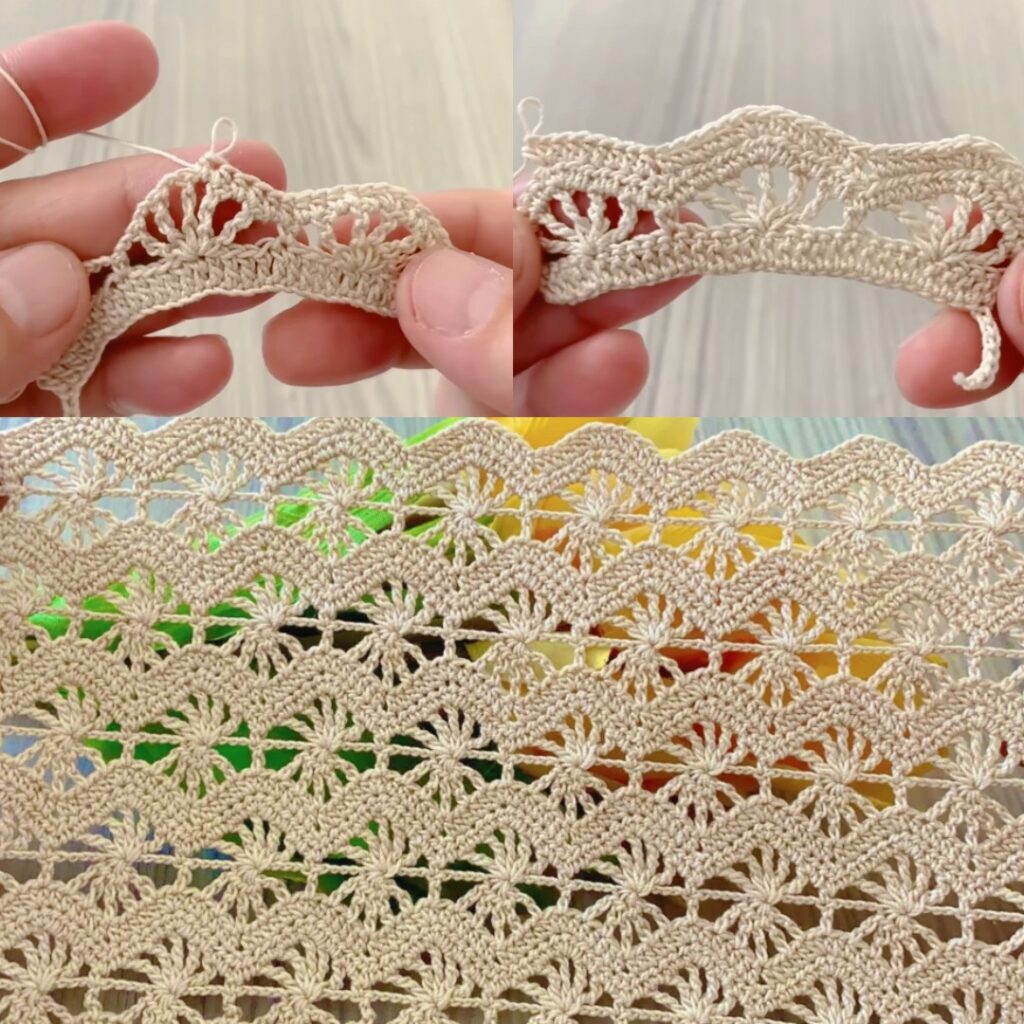
Round 5 — tall lacy arches
- From petal tip: sl st to tip → ch 7 → anchor into the sc round between the next petals with (tr, ch 2, tr, ch 2, tr) worked into that sc/space → sl st back to petal tip.
- Repeat around → 8 arches. Join.
Check: 8 arches
Round 6 — ribs inside arches
- Into each ch-arch: sl st to arch base → ch 3 → dc into top of 1st tr → ch 1 → dc into top of middle tr → ch 1 → dc into top of last tr → ch 3 → sl st to arch base.
(Simpler: 3 dc separated by ch-1 inside each arch.) - Repeat ×8. Join.
Check: 3 ribs per arch
Round 7 — convert circle → square (side & corner loops)
- Mark four quarter points (every 2 petals). Rejoin at a quarter marker.
- Work each side between corners using the same counts on every side. Example starter layout (adjust to your motif size):
sc 10, (sc, ch 4, sc) × 3 (side loops), sc 10 → ch 6 (corner loop).
Important: use identical numbers on all four sides so motifs line up when joining. - Repeat for all sides and join.
Check: 4 corner ch-6 loops; identical side loops on each side — motif will block into a square.
Round 8 — scalloped picot outer edge (finish & JAYG round)
- Rejoin and work the decorative scallop: sc 3, (pic: ch 3, sl st into same st), sc 4 — adjust sc counts so scallop sits flat across each side loop.
- JAYG: when your new motif meets a finished neighbour, replace the picot or sl st at that meeting point with sl st into the corresponding stitch/picot of the finished motif to join. Continue around and finish motif. Fasten off and weave ends.
Check: scallops and picots even after blocking
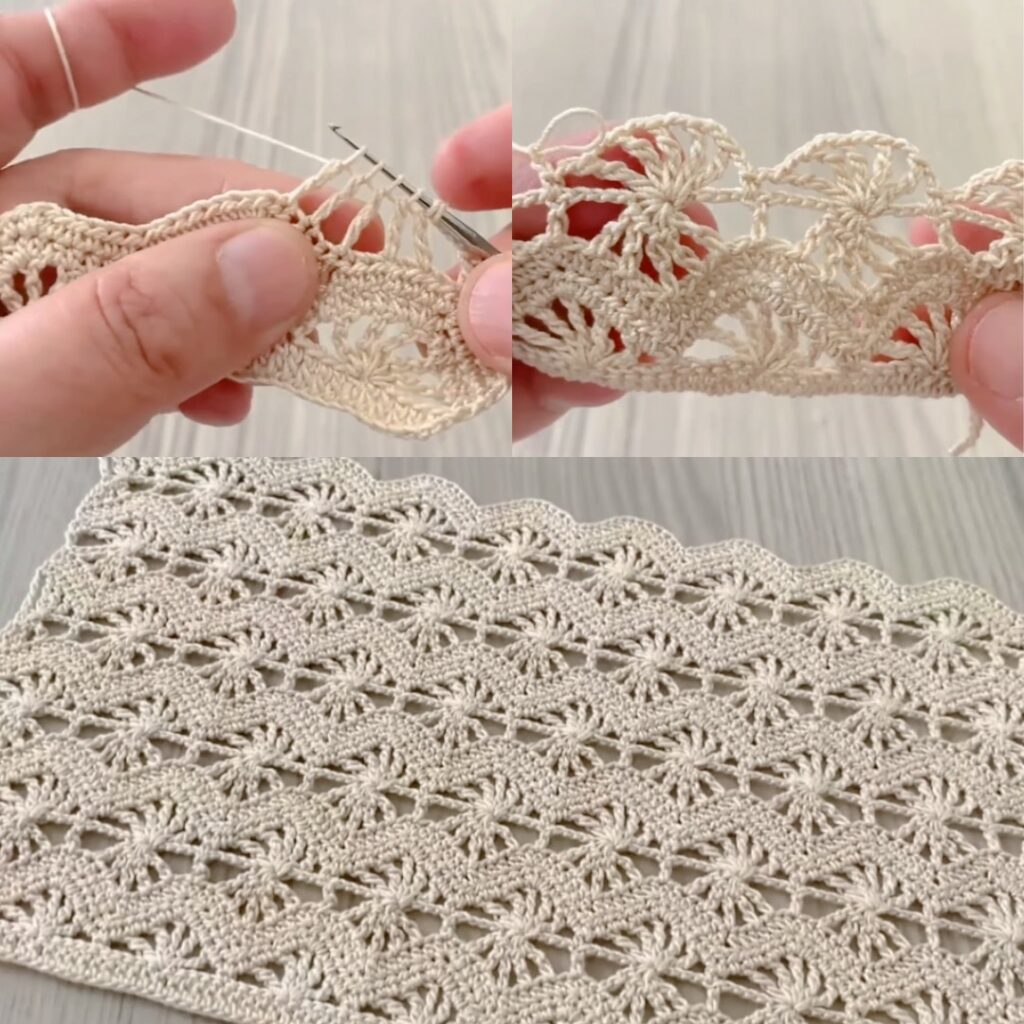
Blocking & prep
- Block every motif pinned to a consistent square: pull corner loops outward and pin scallop peaks/picots. Mist with water or steam and let dry completely. Blocking ensures accurate measurement and flat joins.
Assembly — building a blouse (one-piece JAYG method)
This method builds a continuous sheet of motifs and leaves gaps for neck and armholes.
Step 1 — measure & compute motif counts
- Block one motif and measure its width M (cm or in).
- Decide finished bust circumference C and desired length L.
- Motifs across for half-chest ≈
round((C/2) ÷ M).- Example: M = 11 cm, C = 92 cm → half ≈ 46 → across_half ≈ 4 motifs → front row = 4 motifs.
- Rows down =
round(L ÷ M).
Step 2 — build the top row (yoke)
- Crochet the first motif fully. Make a second motif; on Round 8 (scallop) JAYG-join it to the first along the side — attach at the matching picots/stitches. Continue until you have the top row across (front width).
- If making continuous front+back as one sheet, build full width; otherwise build front panel then back.
Step 3 — form neckline
- For boat/round neckline: skip joining the centre 1–2 picots between central motif(s) in the top row to create a neck opening. For a deeper scoop, omit a whole central motif or leave more joins open.
- You can shape gradually by leaving joins in a wedge to form a V if you prefer.
Step 4 — add rows downwards (body)
- Add motifs row by row using JAYG: when adding a motif, connect it to the motifs to its left and the row above by replacing the corresponding picots/sl sts with sl sts into the already finished motifs. This builds a flat, joined sheet.
- Armholes: when you reach side edges where sleeves will be, leave side joins unworked for the height of the armhole (cap ≈ 1 motif high; short sleeve ≈ 2 motifs; long sleeve ≈ 3+). Continue building body rows under the armhole.
Step 5 — sleeves (options)
- Sleeveless: leave openings and finish with sc + picot edge.
- Short/cap sleeve: make small strips of motifs (1–3 motifs wide) and JAYG them into the armhole opening.
- Full sleeves: build rectangular motif sleeve panels and sew or JAYG them into armholes (requires cutting/assembling; make sure counts line up).
Step 6 — finishing edges
- Pick up stitches around neckline & armholes and work 2 rounds sc; add picot or small scallop round for decoration. For hem, add 1 round dc or hdc for weight so the blouse hangs nicely.
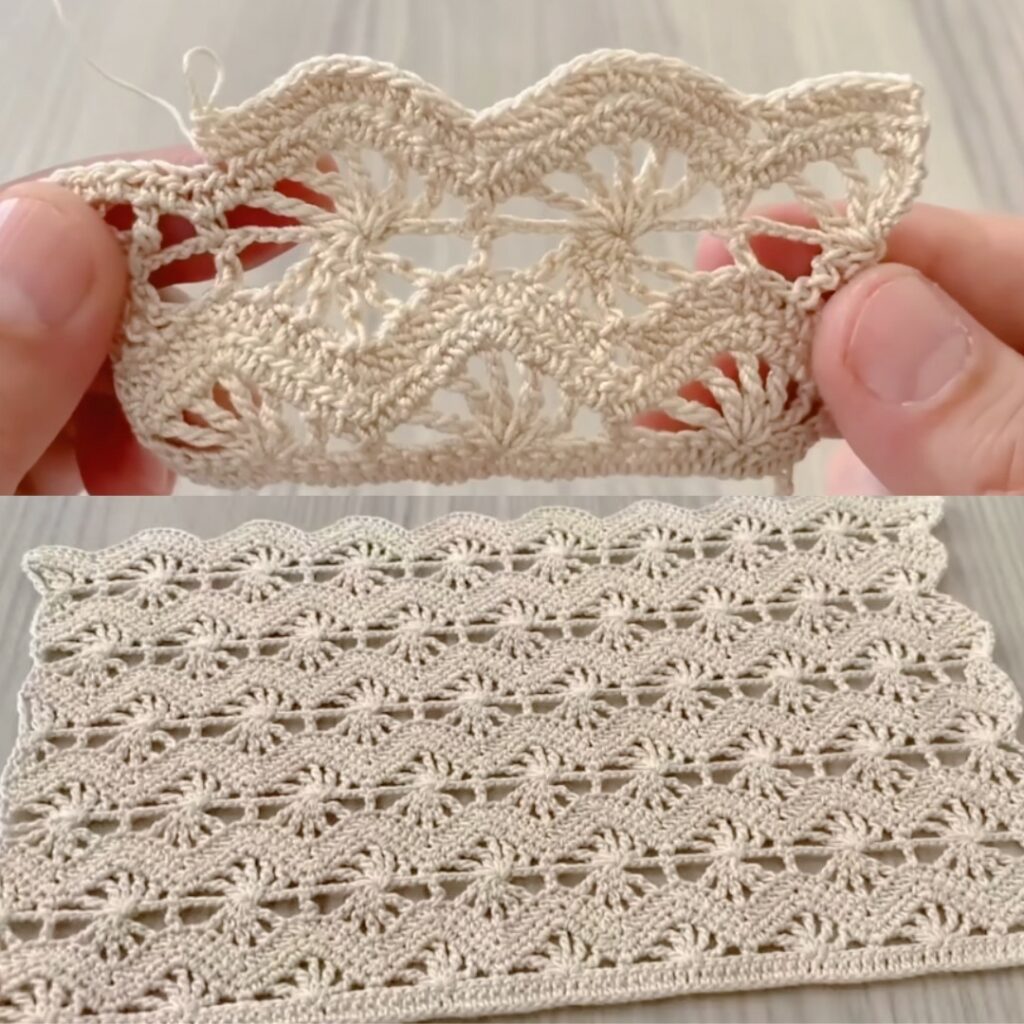
Example layouts (starter)
- Casual top (S): front panel 4 motifs × 4 rows (adjust rows for length), back panel same, join shoulders or build continuous sheet with neckline gap.
- Tunic: increase rows to get desired length (e.g., 6–8 rows).
- Beach cover-up: large motifs, looser yarn, many rows for long tunic length.
Stitch counts & checks (handy)
- R1: 16 dc.
- R2: 8 ch-4 spaces.
- R3: 8 petals.
- R5: 8 arches.
- R7: 4 corner ch-6 loops + identical side loop counts (user defined).
If any count is off, rip to last correct round and fix before continuing — it saves alignment headaches later.
Blocking, washing & care
- Block motifs and assembled garment to final dims. For cotton: gentle handwash, reshape wet, dry flat. Avoid heavy heat ironing; press lightly if needed. For drapey yarns follow yarn care.
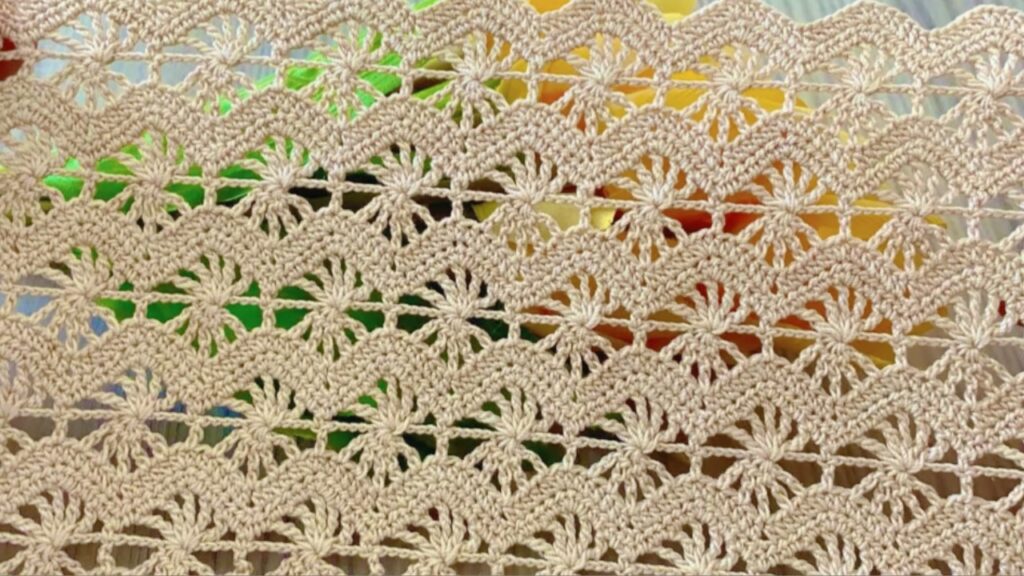
Troubleshooting & quick fixes
- Motifs cup/ripple: shorten arch chains (ch-7 → ch-6) or loosen tension; try slightly larger hook for arches/petals; block more firmly.
- Motifs not lining up when joining: ensure Round 7 side counts are identical on every motif. This is the most common join problem.
- Joined seams gape: use slightly firmer tension for sl st joins or add an extra sl st at each meeting point; blocking helps.
- Neckline too wide/narrow: adjust by skipping more/less joins or omitting central motif(s). You can always add a sc edging to reduce opening.
Variations & styling ideas
- Two-color: change color after Round 3 (petals) to make flowers pop.
- Smaller delicate top: fingering yarn + smaller hook; reduce petal dc (7 → 5).
- Longer tunic: add more motif rows or use thicker yarn & larger hook for larger motif size.
- Fringe or tassels: add fringe to hem for boho look.
- Lining: add a camisole or lightweight lining for modesty if desired.
VIDEO: